BUST: Majora Carter
 Saturday, April 22, 2006 at 02:15AM
April/May 2006
BEAUTY AND THE BRONX
For Majora Carter it's not easy being green
When Majora Carter got the call telling her she'd received the prestigious 2005 MacArthur Foundation Prize, she couldn't believe it--literally. "I thought I recognized the phone number as a friend of mine," she says, laughing, "so I gave him some attitude." Carter's attitude, however, is exactly what earned her the so-called "genius grant" in the first place. Relentlessly committed to initiating to environmental improvements in her native South Bronx, Carter has been slowly realizing her vision to "green the ghetto," an endeavor she hopes will one day transform her smokestack surroundings into an Emerald City of parks.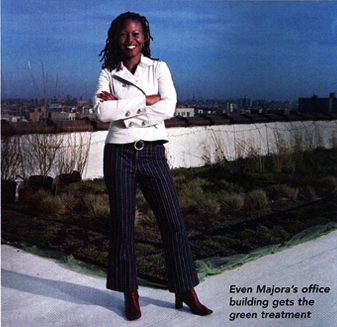 The 38-year-old's path to activism was a rocky one. In the '70s, Carter watched her tight-knit urban neighborhood deteriorate into a smoldering wasteland. "The whole block smelled like burning," she recalls. Industrial plants moved in, people moved out, and when she graduated from high school, Carter jumped at the chance to jet. After studying film at Wesleyan, however, she moved back home in the late '90s and soon heard about the city's proposal to build a major waste-transfer station in the South Bronx, an area already handling 40 percent of NYC's trash. It was then that she and her friends decided enough was enough, so they fought the plan—and won. "Suddenly, it was attitude city," she says of her political emergence. "No one ever asked residents what they didn't want, but no one asked them what they did want, either."
To address these issues, Carter founded Sustainable South Bronx in 2001. Through this community organization, she has planned a "greenway" where residents can work out and helped to open the neighborhood's first waterfront park in 60 years—a project that began after her dog, Xena, led her to the hidden Bronx shoreline through an illegal junkyard. Giving pointers for young activists, Carter advises, "Use the energy that you have, and recognize that you get a lot of crap for being younger. No matter how small you are, you have to act like you're enormous."

 Using a mix of analog tools and software programs like Sonic Solutions, a mastering engineer polishes raw mixed tracks from the recording studio and enhances their flavor. "In a nutshell, mastering engineers make albums sound better," she explains. Lazar, who grew up in a musical household, first got hooked on engineering while playing in her own band after college. In 1997, after getting her master's degree at NYU, Lazar founded The Lodge, a state-of-the-art mastering house in New York City. Her current projects include Garbage's “Bleed Like Me” and Mates of State's “Like U Crazy.”



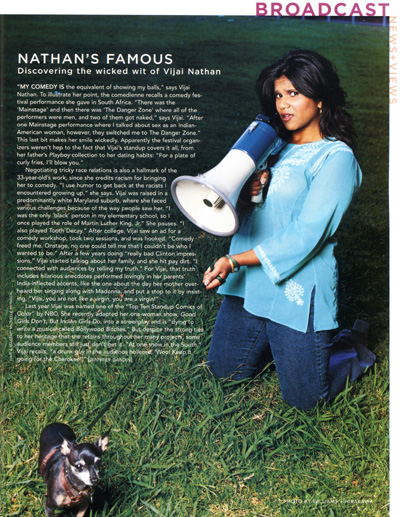 Negotiating tricky race relations is also a hallmark of the 33-year-old's work, since she credits racism for bringing her to comedy. "I use humor to get back at the racists I encountered growing up," she says. Vijai was raised in a predominantly white Maryland suburb, where she faced various challenges because of the way people saw her. "I was the only 'black' person in my elementary school, so I once played the role of Martin Luther King, Jr." She pauses. "I also played Tooth Decay." After college, Vijai saw an ad for a comedy workshop, took two sessions, and was hooked. "Comedy freed me. Onstage, no one could tell me that I couldn't be who I wanted to be." After a few years doing "really bad Clinton impressions," Vijai started talking about her family, and she hit pay dirt. "I connected with audiences by telling my truth." For Vijai, that truth includes hilarious anecdotes performed lovingly in her parents' India-inflected accents, like the one about the day her mother overheard her singing along with Madonna, and put a stop to it by insisting, "Vijai, you are not like a virgin, you are a virgin!"